When a factory floor starts holding onto grease, dust, metal filings or pallet debris, the problem is never just appearance. It slows work down, raises slip risks, affects hygiene standards and can even shorten the life of equipment. The best factory floor cleaning methods are the ones that match your site, your shift pattern and the kind of mess your operation creates.
A food production area, for example, needs a very different approach from an engineering workshop or a warehouse with constant forklift traffic. That is where many businesses lose time and money – they use one cleaning routine for every zone and hope for the best. A smarter plan separates dry contamination from wet spills, routine cleaning from deep cleaning, and low-risk areas from high-compliance ones.
Why factory floor cleaning methods need to be site-specific
Factory floors take punishment. Tyre marks build up near loading areas, oil collects around machinery, dust settles in corners and under racking, and busy walkways can become hazardous long before the end of a shift. If cleaning is too light, residue stays behind. If it is too aggressive, the floor finish can wear out faster or operations can be disrupted unnecessarily.
That is why there is no single best method for every premises. Concrete, resin, painted floors and anti-slip surfaces all respond differently to scrubbing pressure, detergents and water use. The right choice depends on what is on the floor, how quickly it needs to be removed and whether the area can be taken out of use.
1. Dry sweeping for loose debris and daily control
Dry sweeping is still one of the most useful factory floor cleaning methods when the issue is loose material rather than sticky residue. In manufacturing and warehouse settings, that often means cardboard fibres, packaging fragments, dust, sawdust, dirt tracked in from loading bays and general debris from foot and vehicle traffic.
Manual sweeping can work in smaller areas or around obstacles, but for larger sites it often just moves dust about unless the tools are right. Dust-control mops and industrial sweepers are a better fit where airborne particles are a concern. They collect more efficiently and reduce the chance of fine dust resettling on stock, machinery or work surfaces.
The trade-off is simple. Sweeping is quick and low-disruption, but it will not deal with grease, dried spills or ingrained grime. It is a control measure, not a full solution.
2. Vacuum cleaning for fine dust and sensitive environments
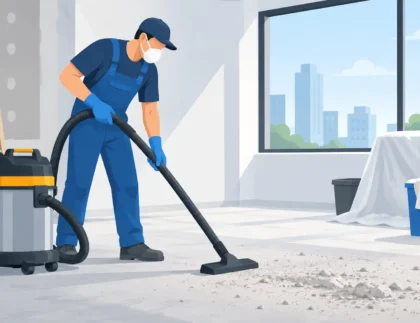
Where fine particles are the main issue, vacuuming is often safer and cleaner than sweeping. This applies in sites where powder, shavings or dry residues can spread easily, especially around production lines, electrical equipment or stored goods.
Industrial vacuums are particularly useful in corners, expansion joints, edges and machine bases where standard sweeping misses the detail. In some environments, using a vacuum with suitable filtration is also the better option for air quality. That matters if your floor contamination includes fine dust that employees could breathe in or that could settle back onto products.
This method is slower than broad sweeping over open floor space, so it usually works best as part of a mixed routine. Open areas may be swept or machine-cleaned, while detailed vacuuming handles the hard-to-reach sections.
3. Scrubber dryer cleaning for routine wet cleaning
For many industrial sites, scrubber dryers are the backbone of regular floor maintenance. They apply cleaning solution, scrub the surface and recover the dirty water in one pass. That makes them especially practical in medium to large spaces where floors need to be cleaned thoroughly without staying wet for long.
This is one of the most efficient factory floor cleaning methods for general grime, tyre marks, light grease and traffic dirt. It suits warehouses, production areas, packing spaces and distribution centres where appearance, safety and speed all matter.
What makes scrubber dryers popular is not just the cleaning result. It is the reduced drying time. In busy premises, wet floors create their own risk and can interrupt movement. A machine that leaves the surface drier after cleaning helps keep operations moving.
That said, results depend heavily on setup. The wrong pad, brush or detergent can leave residue behind or fail to shift contamination properly. Very uneven floors or tightly packed areas may also need manual work alongside the machine.
4. Degreasing for oil, lubricant and heavy soil build-up
In workshops, engineering plants and machinery-heavy environments, grease is often the real challenge. Standard floor detergent may improve the appearance slightly, but it will not always break down oil-based contamination effectively. In these cases, degreasing is essential.
A proper degreasing process usually starts with identifying the type of residue. Hydraulic oil, machine lubricant, food oil and chemical spill residue do not all respond in the same way. Using the wrong product can waste time or create a slippery film rather than remove the problem.
The safest approach is usually controlled application, agitation and full removal of the contaminated solution rather than simply pushing it across the floor. On heavily soiled sites, this may need to be repeated in stages. It is more labour-intensive than routine cleaning, but when grease is left to build up, the floor quickly becomes a safety issue rather than just a cleaning one.
5. Pressure washing for external and heavy-duty areas
Pressure washing can be very effective, but it is often overused indoors and underplanned outdoors. It suits loading bays, yards, waste holding areas and some industrial entrance points where heavy dirt, mud, algae or external grime build up over time.
Used correctly, pressure washing removes stubborn contamination quickly. Used badly, it can spread dirt, force water into the wrong places and create drainage problems. Indoors, it is only suitable in specific environments where water use is safe and controlled, and where the floor and surrounding equipment can tolerate that level of moisture.
This is a good example of a method that depends on the site. For one factory, pressure washing is the fastest way to restore a heavily soiled service yard. For another, it is the wrong choice entirely because water control, safety and drying time make it impractical.
6. Steam cleaning in hygiene-critical zones
Steam cleaning has a place where hygiene matters and chemical use needs to be limited or carefully managed. It is especially useful for certain food-related, medical-adjacent or specialist production areas where high-temperature cleaning can help loosen grime and support sanitisation.
The main benefit is targeted cleaning with less reliance on heavy chemical application. It can be effective around edges, drains, joints and equipment bases where contamination tends to collect. It also uses far less water than some traditional wash-down methods.
Still, steam cleaning is not a universal answer. It can be slower across very large floor areas, and some surfaces or coatings may not be suited to repeated high heat. It works best where detail and hygiene standards matter more than sheer floor coverage speed.
7. Scheduled deep cleaning for neglected build-up
Even with a solid daily routine, factory floors eventually need a deeper reset. This is where periodic deep cleaning comes in. It tackles the grime that routine passes miss – built-up residues in corners, staining around fixed machinery, compacted dirt in textured flooring and contamination under shelving or racking.
Deep cleaning is often the difference between a floor that looks passable and one that is genuinely clean and safer to use. It is also the best time to deal with areas that are not practical during a normal working day.
For many businesses, this is best arranged outside core operating hours to avoid disruption. A professional team can often complete far more in one planned session than in weeks of piecemeal in-house effort. That is particularly true on larger commercial sites where the right machines, chemicals and experience make a visible difference.
Choosing the right factory floor cleaning methods for your site
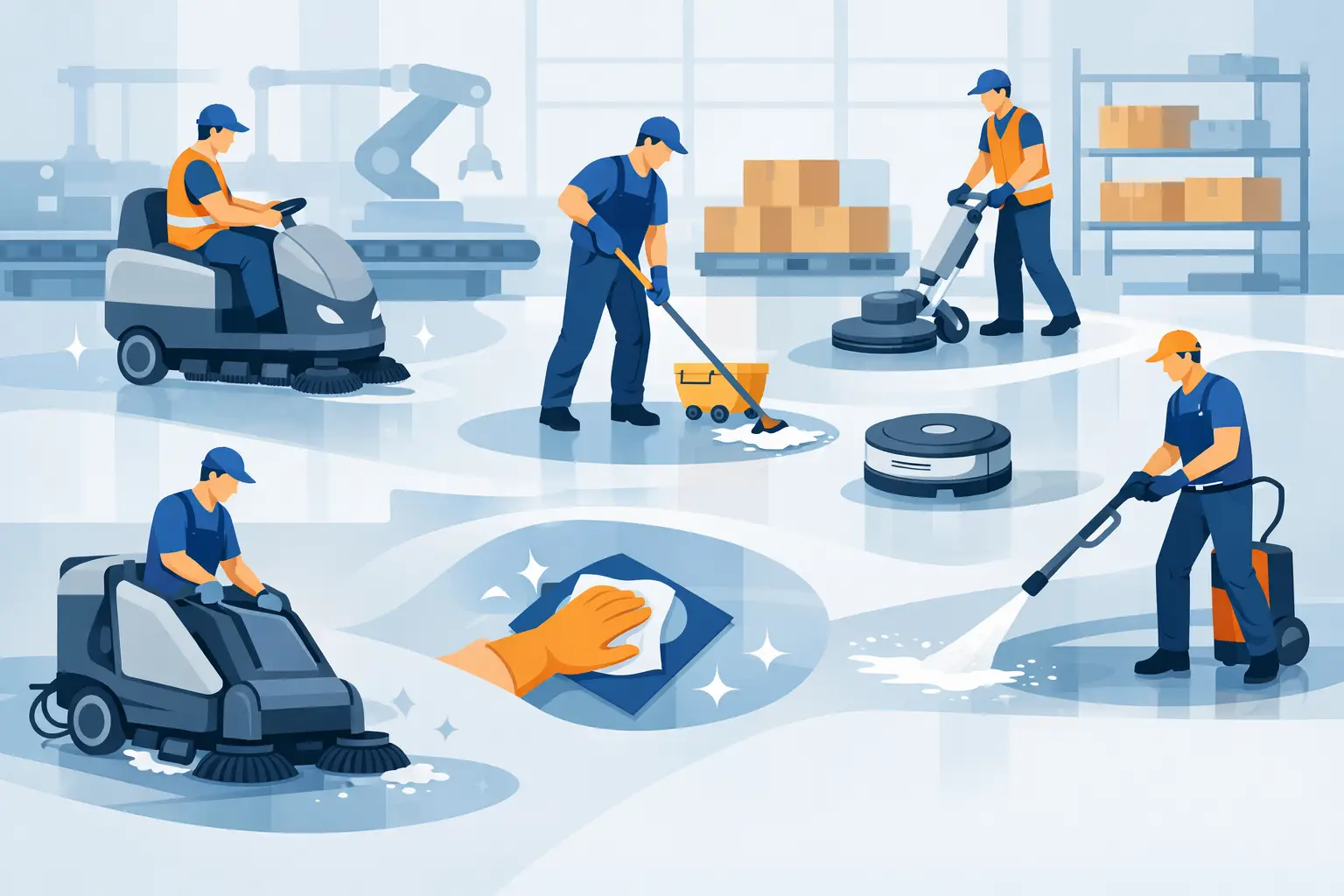
The best cleaning plan usually combines several methods rather than relying on one. Dry sweeping or vacuuming may control loose debris through the day. A scrubber dryer may handle routine cleaning after shifts. Degreasing may be needed around machinery, while pressure washing or steam cleaning may be reserved for specific zones.
The key questions are practical ones. What type of contamination appears most often? How quickly does it build up? Which areas are safety-critical? Can the floor be cleaned during production, or only after hours? And just as importantly, what kind of floor surface are you working with?
If your site includes different zones, treat them differently. A loading bay, a packing area and a production floor should not all be cleaned in exactly the same way. Matching the method to the risk is what keeps standards high without wasting labour or causing unnecessary downtime.
When to bring in professional support
Some sites can manage daily floor upkeep internally, but specialist support becomes valuable when cleaning is falling behind, contamination is recurring, or compliance expectations are high. Professional cleaners bring equipment that most businesses do not keep on site, and they can usually spot problems in the routine before they become bigger issues.
That is often the practical benefit for London businesses – less guesswork, fewer disruptions and a cleaning plan that fits the way the site actually runs. For factories, warehouses and other commercial premises, the goal is not just a cleaner floor. It is a safer, more efficient working environment that does not get in the way of the job.
If your floor is always being cleaned but never really looks or feels under control, that is usually a sign the method needs changing, not just the effort level. The right system makes the whole site easier to manage.