If you have ever asked for a quote and been offered either a commercial cleaning plan or a janitorial service, you are not alone. Commercial cleaning versus janitorial services is one of the most common points of confusion for businesses, landlords, and facilities teams – especially when both sound like they should cover the same job.
They do overlap, but they are not identical. The difference usually comes down to scope, frequency, skill set, and the type of result you need. Get that wrong, and you can end up paying for the wrong service, missing key tasks, or expecting a deeper clean than your contract actually includes.
Commercial cleaning versus janitorial services: the basic difference
The simplest way to separate them is this. Janitorial services are usually routine, ongoing cleaning tasks that keep a space tidy, hygienic, and presentable day to day. Commercial cleaning is often broader and can include heavier-duty, specialist, or periodic cleaning work for business premises.
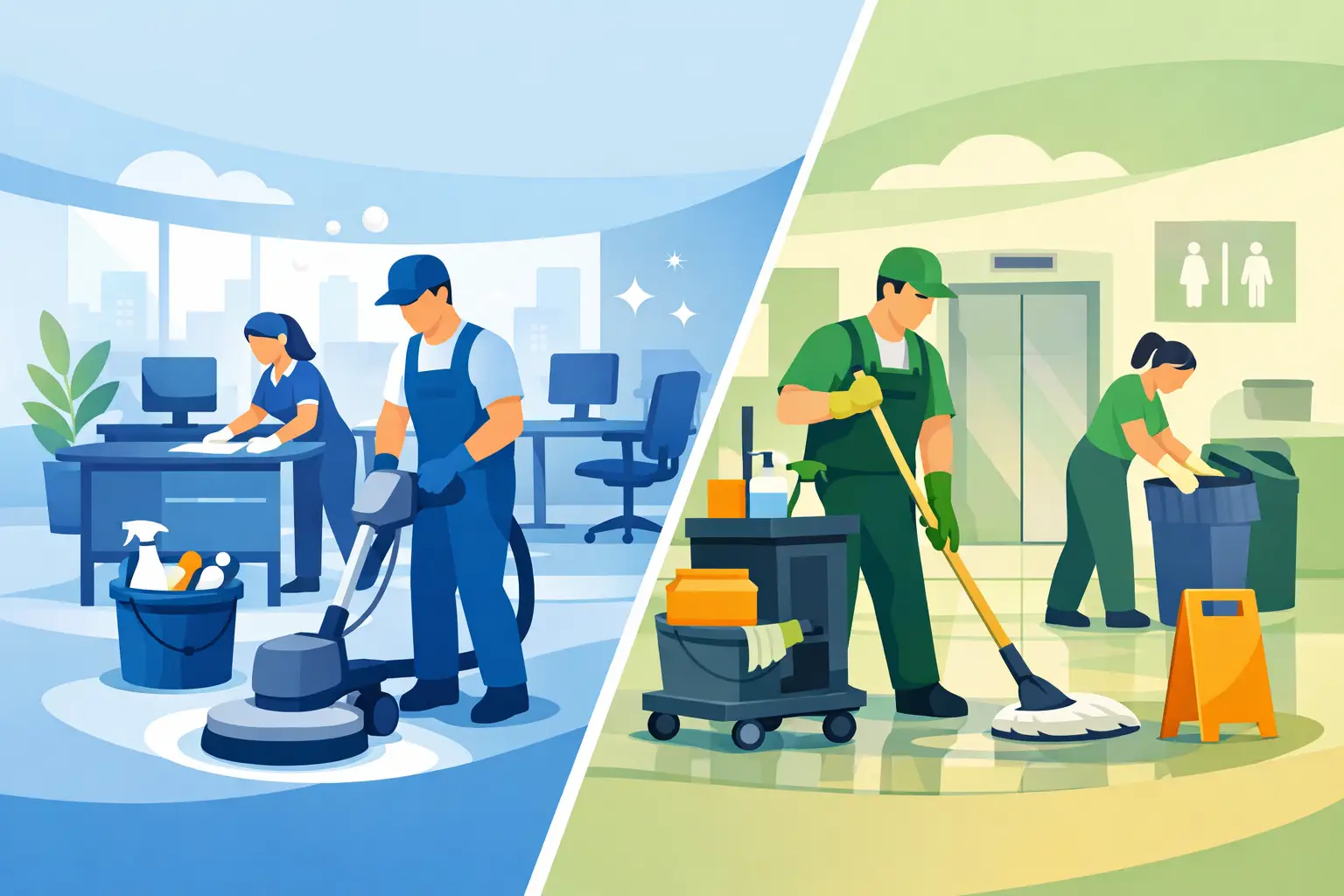
A janitorial team might empty bins, clean washrooms, wipe desks, vacuum floors, and keep kitchens in order on a daily or scheduled basis. A commercial cleaning team may handle those needs too, but is more likely to be brought in for deep cleaning, carpet cleaning, post-build cleans, machine floor cleaning, high-level dusting, window cleaning, or sector-specific sanitisation.
That is why the wording matters. If you run an office in Westminster, manage a restaurant in Camden, or oversee a warehouse in Wembley, the right service depends less on the label and more on what the site actually needs.
What janitorial services usually include
Janitorial work is about upkeep. It keeps the building usable and consistent between deeper cleans. In many workplaces, that means cleaning happens daily, several times a week, or on a set schedule outside business hours.
Typical janitorial tasks include wiping surfaces, mopping hard floors, vacuuming carpets, sanitising washrooms, replenishing consumables, cleaning staff kitchens, and removing rubbish. In offices, it may also include touchpoint cleaning around reception desks, meeting rooms, door handles, and lift buttons.
For many businesses, janitorial support is the backbone of cleanliness. It is not glamorous, but it is what stops an office looking tired by Wednesday or a shared building smelling neglected by Friday.
The trade-off is that janitorial services do not always go deep. They maintain standards, but they may not deal with ingrained dirt, post-renovation dust, stained carpets, greasy extraction areas, or specialist hygiene requirements unless those tasks are clearly built into the agreement.
When janitorial services make sense
Janitorial cleaning is usually the better fit when your premises need regular attention rather than occasional intensive work. Offices, communal residential blocks, schools, clinics, retail units, and shared workspaces often benefit from this model because the goal is consistency.
It also suits sites with predictable footfall. If your priority is making sure washrooms stay clean, bins do not overflow, and floors are presentable every day, janitorial services are often the practical answer.
What commercial cleaning usually includes
Commercial cleaning is a wider category. It refers to professional cleaning for business premises, but in practice it often includes more specialist or task-based work than janitorial contracts do.
This can cover deep office cleaning, post-construction cleaning, carpet and upholstery cleaning, hard floor stripping and polishing, window cleaning, warehouse cleaning, medical facility cleaning, showroom cleaning, restaurant deep cleaning, and factory cleaning. It may be one-off, scheduled monthly, quarterly, or tied to operational needs such as audits, handovers, events, or refurbishment work.
A commercial cleaning team is often expected to bring different equipment, different training, and a more tailored method. Cleaning a medical site is not the same as cleaning a shop. A warehouse with dust build-up, loading bays, and heavy traffic needs a different approach from a small office suite.
That flexibility is a major advantage. If your building has specialist surfaces, high-traffic areas, compliance pressures, or occasional heavy cleaning demands, commercial cleaning gives you more room to match the service to the site.
When commercial cleaning is the better fit
Commercial cleaning makes more sense when ordinary upkeep is not enough. If your premises need deep cleaning, specialist sanitisation, stain removal, floor machinery, post-build clearance, or sector-specific standards, that usually falls under commercial cleaning.
It is also the better choice when the environment creates more wear and mess than a standard office. Restaurants, gyms, warehouses, medical facilities, factories, airports, and customer-facing retail sites often need more than routine maintenance.
Why people confuse the two
The confusion comes from the fact that many cleaning companies provide both. A business might ask for office cleaning and be offered a janitorial contract. Another might request janitorial support and also need periodic commercial deep cleaning without realising it should be quoted separately.
There is also no universal rule across the industry. Some providers use commercial cleaning as an umbrella term for all business cleaning. Others use janitorial to describe the regular part and commercial cleaning for specialised work. Neither approach is wrong, but it does mean customers need to ask better questions.
Instead of focusing only on the label, ask what is included, how often the service happens, what equipment is used, and whether deeper tasks are part of the contract or charged separately.
Commercial cleaning versus janitorial services: choosing the right one
Choosing between commercial cleaning versus janitorial services starts with a simple question. Are you trying to maintain a clean space, restore a neglected one, or manage both?
If you only book a deep clean once in a while but have no regular upkeep, standards can slip fast. If you only have light daily cleaning but never schedule periodic deep cleaning, hidden dirt, stains, odours, and wear build up over time.
For many London businesses, the best answer is a combination. Regular janitorial visits handle the day-to-day basics, while commercial cleaning is booked for the heavier tasks that protect appearance, hygiene, and lifespan.
A small office may only need evening janitorial cleaning with quarterly carpet cleaning. A restaurant may need daily janitorial support plus kitchen deep cleans. A managed block may need communal janitorial cleaning with periodic window and machine floor cleaning. It depends on the building, the traffic, and how quickly cleanliness affects staff, visitors, or customers.
Questions worth asking before you book
Before agreeing to any service, be clear about what success looks like. Do you want the space to stay presentable every day, or are you trying to fix a problem that has built up over months? Is hygiene the top issue, or appearance, or compliance?
It also helps to ask who uses the building and how. An office with hybrid staff has different needs from a clinic, a showroom, or a warehouse. The more footfall, food handling, shared touchpoints, and public access you have, the less likely a basic routine clean will be enough on its own.
You should also check whether consumables, internal glass, carpet care, washroom servicing, and deep cleaning are included. Assumptions are where most cleaning contracts go wrong.
Cost, value, and what you are really paying for
Many buyers compare prices before they compare scope. That is understandable, but it often leads to a poor fit.
Janitorial services may appear cheaper because they are built around repeat, routine tasks. Commercial cleaning may cost more per visit because it involves more labour, specialist products, machinery, access equipment, or trained staff. That does not mean one offers better value than the other. It means they solve different problems.
A cheap janitorial contract that does not cover the tasks your premises actually need will create frustration fast. On the other hand, booking specialist commercial cleaning too often for a low-impact site can be unnecessary spend.
The right value comes from matching the service to the environment. A cleaning plan should reflect how the property is used, what standards matter, and how quickly issues become visible.
The service model that works for most businesses
For most commercial sites, the strongest setup is not choosing one side and ignoring the other. It is building a cleaning plan with layers.
Routine janitorial cleaning keeps the property under control. Scheduled commercial cleaning deals with the heavier, less frequent work that routine visits do not cover well. Together, they create a site that looks cared for, feels hygienic, and stays easier to manage.
That is particularly useful for busy London properties where public impression matters and downtime is expensive. A flexible provider can scale the service around your site, whether you need office cleaning, specialist commercial support, or both. Companies such as The Ultimate Cleaners often work this way because real buildings do not fit neatly into one label.
If you are weighing up what to book, do not get stuck on terminology. Focus on the result you need, the tasks included, and how the space is used each day. The right cleaning service should make life easier, not leave you guessing what was meant to be covered.