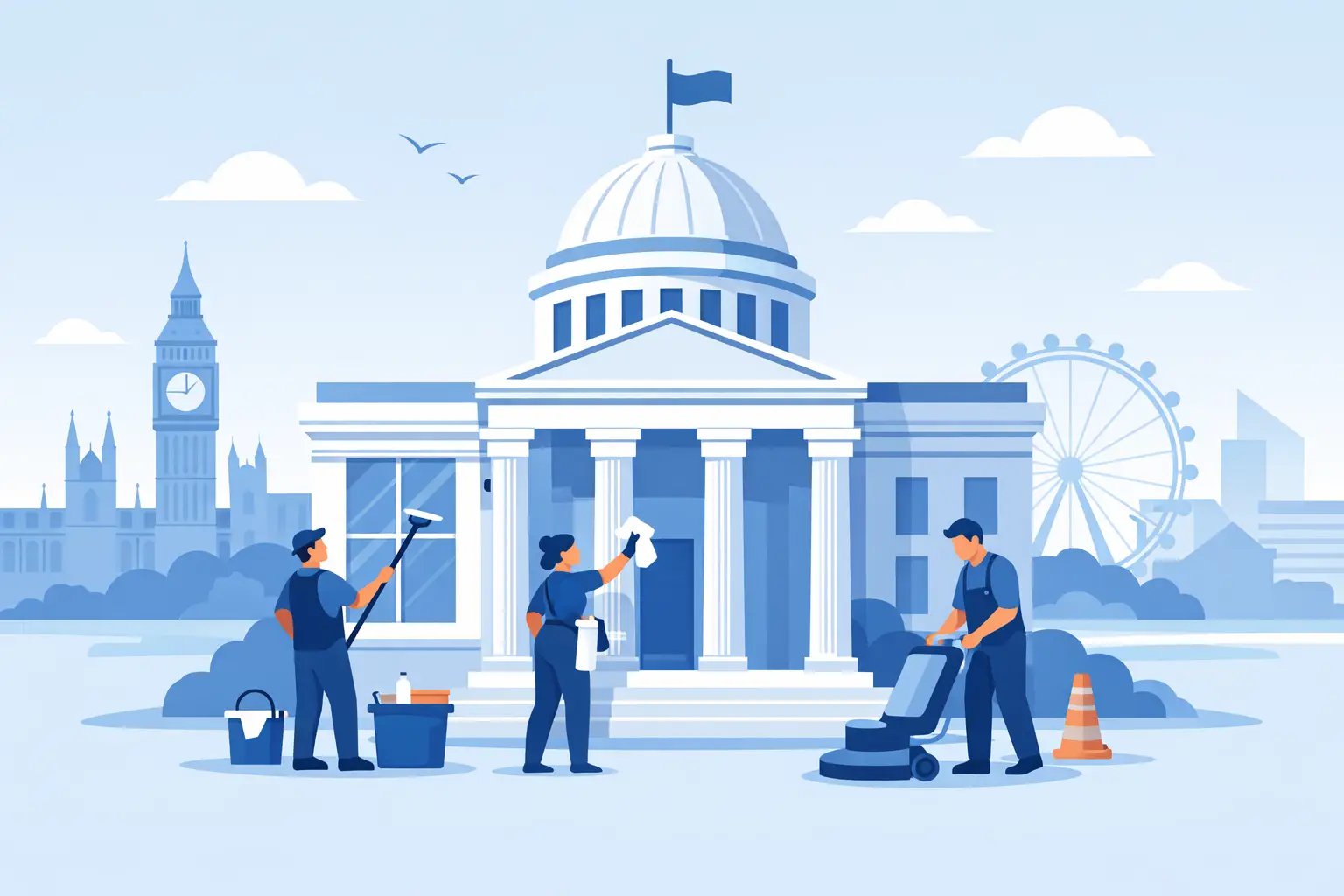
A government building cleaning guide cannot treat the site like a standard office. A busy civic building may contain public counters, secure work areas, meeting rooms, records storage, staff kitchens and washrooms under one roof. Each space has a different risk level, access rule and expectation of presentation.
For facilities teams, the aim is simple: provide a clean, safe and welcoming environment without interrupting public services or compromising security. That takes a planned routine, properly briefed operatives and enough flexibility to respond when footfall, weather or events change the day.
Start with the building’s real use, not a generic checklist
The best cleaning plan follows how people actually move through the building. Reception areas and service desks may see queues from opening time. Corridors near public meeting rooms can become dirty within hours in wet weather. Back-office floors may need less frequent attention but can hold confidential documents, specialist equipment or restricted-access areas.
Walk the site at different times before setting frequencies. Note entrance routes, lift lobbies, touchpoints, washrooms, waiting areas, stairwells, kitchens, bin stores and any spaces used for public appointments. Speak with reception, security and building users too. They will usually identify pinch points that a site survey alone can miss.
A plan should separate three types of work: routine cleaning, periodic deep cleaning and responsive cleaning. Routine work keeps daily areas presentable. Deep cleaning deals with built-up soil in carpets, hard floors, upholstery, high-level surfaces and neglected corners. Responsive work covers spills, weather-related mess, high-profile visits and unexpected incidents.
Government building cleaning guide: prioritise risk and access
Government facilities have an added layer of responsibility. Cleaners must work around security procedures, visitors and sensitive information while completing the job properly. That does not always mean every operative needs access everywhere. In fact, limiting access to the areas required is often the sensible approach.
Divide the site into clear zones
Public zones include entrances, waiting rooms, public washrooms and customer-service areas. These usually need repeated checks through the day because appearance and hygiene are immediately visible to visitors.
Staff zones cover offices, kitchens, staff washrooms and meeting rooms. Cleaning can often be scheduled before opening, after closing or around agreed quiet periods. Secure zones may include records rooms, controlled offices, IT spaces and areas with restricted documents. These need defined entry procedures, clear supervision arrangements and a firm rule that nothing is moved, read or photographed unless specifically authorised.
Keep cleaning cupboards, chemicals and equipment secure as well. Products must never be left unattended in public areas, particularly near children, vulnerable visitors or busy reception points.
Build security into the method statement
Cleaning teams need a site-specific induction, not just a general health and safety briefing. They should know which entrances to use, how to sign in and out, what ID to carry, where they may take breaks and who to contact if they find an unsecured door, unattended bag, damaged lock or confidential paperwork.
A good procedure also explains what cleaners should not do. They should not attempt to resolve a security incident, handle suspicious items or make assumptions about documents left on desks. Escalation routes need to be quick and clear, especially on an occupied public site.
Focus daily attention where the public notices it first
Visitors may not see every cleaned skirting board, but they will notice fingerprints on glass, an overflowing bin, a poorly stocked washroom or a sticky reception floor. These details shape confidence in the building and the service being delivered inside it.
Entrances should be checked regularly, with mats vacuumed or cleaned as needed and wet floors dealt with promptly. During rain, more frequent checks are safer than relying on warning signs alone. Reception desks, seating, door furniture, lift buttons, handrails and self-service screens should be cleaned according to the building’s use and the manufacturer’s guidance.
Washrooms need more than one end-of-day clean in a high-footfall building. Schedule inspections for cleanliness, odour, consumables, blocked fixtures and floor condition. A visible check record can help staff report issues quickly, but it should support proper inspections rather than become a box-ticking exercise.
Clean first, then disinfect when it is justified
Cleaning removes visible dirt and reduces contamination by lifting it from a surface. Disinfection is a separate step and is most useful on appropriate high-touch areas, after bodily-fluid incidents or where the building’s risk assessment calls for it. Applying disinfectant to a dirty surface is rarely effective and can waste product.
Use products correctly, including dilution and contact time. More chemical is not automatically better. Excess product can leave residues, damage finishes and create slip risks. Eco-friendly cleaning products can be a good fit for government sites, particularly where indoor air quality and public-facing spaces matter, but they still need to be suitable for the task and used as directed.
Protect staff, visitors and the building fabric
Government properties range from modern service hubs to older civic buildings with delicate finishes, stone floors, wood panelling and historic fixtures. A harsh product or poorly chosen machine can cause costly damage. Test methods in an inconspicuous area where necessary, follow floor and surface care guidance, and schedule specialist work for materials that need it.
Manual handling, slips and trips remain everyday risks. Operatives need enough time to work safely rather than rushing between tasks. Cables, wet-floor signs, mop buckets and cleaning trolleys must be positioned so they do not block fire routes, accessible routes or busy corridors.
Accessibility deserves the same attention. Keep lowered counters, induction-loop areas, accessible toilets and entrance routes clean and unobstructed. When cleaning is carried out while the building is open, choose quieter times for noisy equipment and communicate clearly with reception staff before working near appointments or public meetings.
Set frequencies that can flex with demand
There is no single cleaning frequency for every government facility. A building open to walk-in visitors from morning to evening needs a different programme from a small administrative office with hybrid staff. The right schedule depends on footfall, opening hours, weather exposure, building layout, vulnerable users and the standard expected by the organisation.
Daily cleaning may cover public floors, washrooms, bins, kitchens, touchpoints and reception areas. Weekly tasks can include detailed dusting, internal glass, furniture care and less-used rooms. Monthly or quarterly work may include carpet cleaning, machine floor care, high-level dust removal, internal window cleaning and deep cleaning of kitchens or washrooms.
Review the programme after the first few weeks. If washroom checks show supplies run out every afternoon, change the service window. If a meeting suite is often booked late, move its clean to an earlier slot. A cleaning contract should work around the building, not force the building to work around the contract.
Measure quality without creating paperwork for its own sake
Quality checks protect standards, but they should be practical. Agree what a clean building looks like in the areas that matter most, then inspect consistently. Photos can be useful for reporting damage or recurring issues, provided site rules permit them and no confidential information is captured.
A useful inspection looks at:
- floor condition, including edges, corners and entrance mats;
- washroom hygiene, odour, consumables and fixtures;
- bins, recycling points and waste-storage areas;
- touchpoints, glass, desks and public-facing furniture;
- safe storage of equipment and compliance with access rules.
Combine scheduled inspections with an easy way for staff to raise requests. A missed bin collection or spill should not wait until the next formal review. Responsive communication is part of the service, particularly when the building is serving the public.
Choose a cleaning partner that can work around public service
Price matters, but the lowest quote can become expensive if it leaves gaps in supervision, consumables, cover for absence or specialist capability. Ask prospective providers how they manage vetting, inductions, quality control, secure access, out-of-hours work and urgent call-outs. Confirm exactly what is included in the scope and what is charged as additional work.
For London facilities teams, local coverage and flexible scheduling can make a real difference when a meeting overruns, weather causes heavy entrance traffic or a public area needs rapid attention. The Ultimate Cleaners can support government facilities with planned commercial cleaning, one-off deep cleans and specialist work arranged around site requirements.
A well-run government building should feel cared for before anyone has to think about cleaning. When the public spaces are calm, the washrooms are ready, routes are safe and staff can focus on their work, the cleaning plan is doing exactly what it should.