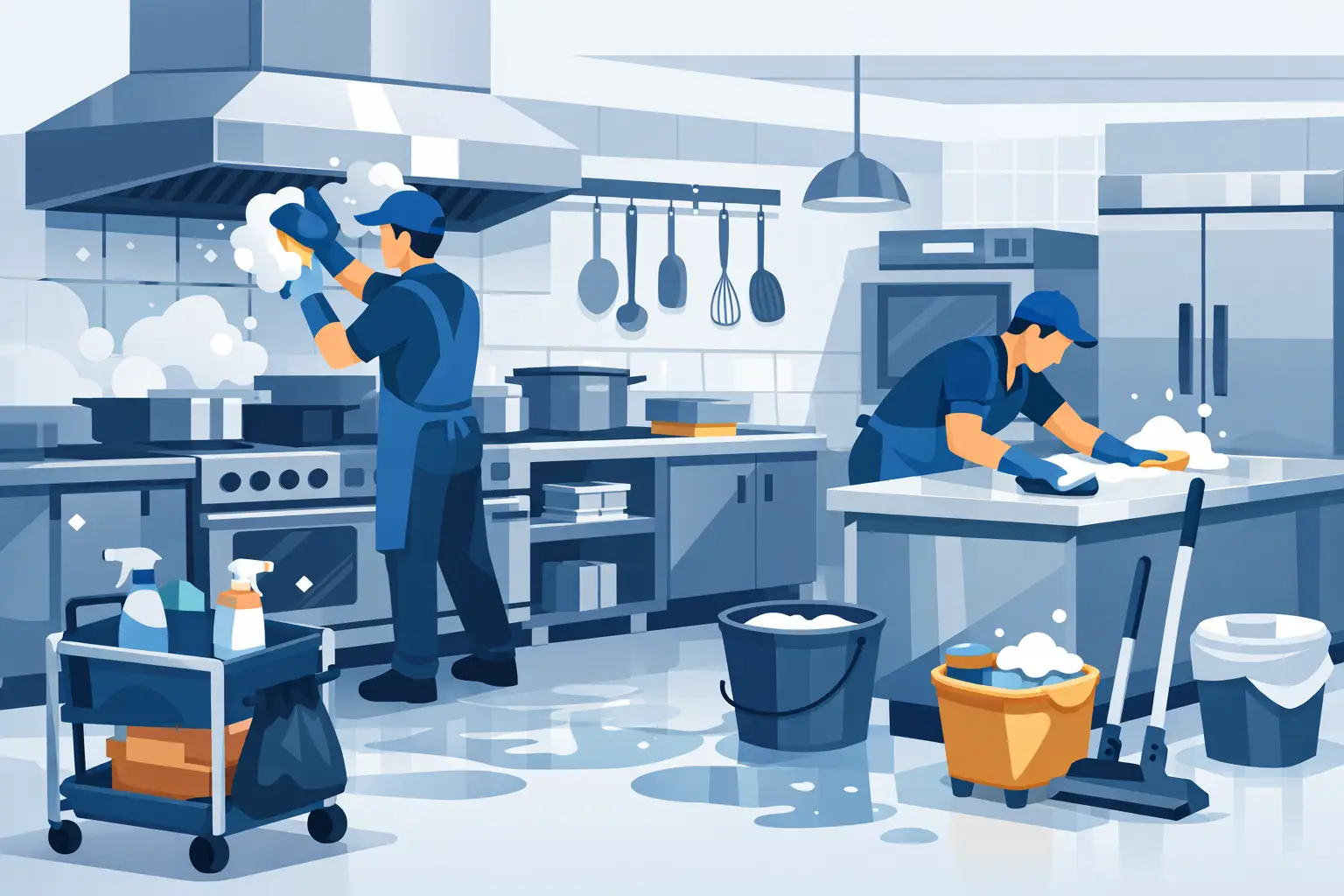
A sticky extractor canopy, grease creeping along tiles, and a floor that still feels tacky after the nightly mop – that is usually the moment a restaurant realises routine cleaning is no longer enough. Restaurant kitchen deep cleaning goes beyond the end-of-shift tidy-up. It tackles the hidden build-up that affects hygiene, safety, equipment performance and, ultimately, customer confidence.
For busy restaurant owners, head chefs and facilities teams, the challenge is rarely knowing that a deep clean is needed. The hard part is finding the time, planning it around service, and making sure nothing important gets missed. In a high-pressure kitchen, grease and food residue do not just look bad. They create slip risks, attract pests, affect air quality and make it harder to keep standards consistently high.
What restaurant kitchen deep cleaning actually covers
A proper deep clean is not simply a more energetic version of daily cleaning. It is a detailed, methodical clean of the areas that are hard to reach, easy to overlook or too disruptive to handle during normal service hours.
That usually includes cook lines, splashbacks, extraction surfaces, floors under heavy equipment, drains, walls, storage shelving, fridges, freezers, door seals and high-touch points. In many kitchens, the dirtiest areas are not the most obvious ones. Grease often collects behind appliances, under prep counters and around canopy edges where routine wipes do very little.
The aim is to bring the kitchen back to a genuinely hygienic baseline. Once that baseline is restored, daily and weekly cleaning become more effective. Without it, staff can be cleaning on top of ingrained grime, which wastes time and still leaves a poor result.
Why deep cleaning matters more in commercial kitchens
A restaurant kitchen works harder than most commercial spaces. There is heat, moisture, fat, food waste, constant foot traffic and a fast turnover of tasks. That combination creates a cleaning problem that builds up quickly, especially in busy periods or smaller kitchens where equipment is packed tightly together.
There is also the issue of compliance. Environmental health expectations are not limited to what customers can see. Inspectors look at cleanliness in working areas, food storage zones and places where contamination risks can develop out of sight. If grease, mould, carbon build-up or food debris are left too long, the consequences can move from inconvenience to genuine business risk.
Then there is staff wellbeing. A cleaner kitchen is usually a safer, easier place to work. Floors are less hazardous, extraction works better, odours are reduced and equipment is easier to use properly. A deep clean does not replace good staff habits, but it supports them.
The signs your kitchen is overdue a deep clean
Some warning signs are obvious. Persistent grease on surfaces, unpleasant odours, stained grout, dirty vents and residue around cooking equipment are all common clues. Others are more subtle. If staff are spending longer cleaning but standards still seem to slip, that often points to built-up dirt that needs a full reset.
You might also notice extractor areas becoming visibly greasy, drainage smells getting worse, cold storage seals discolouring, or pest control issues becoming more frequent. Even a kitchen that appears acceptable at first glance can have serious build-up underneath and behind equipment.
This is where trade-offs come in. Some restaurants can manage with scheduled deep cleans every few months because daily controls are strong and cooking volumes are moderate. Others, especially high-output kitchens with lots of frying or grilling, may need them far more often. It depends on menu, layout, equipment load and how disciplined routine cleaning is during service and close-down.
Restaurant kitchen deep cleaning by area
The cook line is usually the heaviest-worked part of the kitchen, so it often needs the most intensive attention. Grease deposits around hobs, ovens, grills and fryers can become stubborn quickly. Cleaning these areas properly means dealing with both visible residue and the film that settles on nearby walls, controls and undersides.
Extraction-adjacent surfaces matter too. While specialist duct cleaning may sit outside a standard kitchen deep clean depending on the provider, the visible canopy, filters and surrounding surfaces still need serious attention. If these are neglected, grease spreads well beyond the cooking zone.
Cold storage is another area where surface cleaning can give a false sense of security. Shelving, seals, handles and corners inside fridges and freezers collect spills and bacteria fast. A deep clean here helps protect food storage standards and reduces odours.
Floors are often the biggest giveaway. In a proper deep clean, floors are not just mopped. They are degreased thoroughly, with attention to corners, edges, grout lines and the areas underneath movable equipment. That is often where old food debris and grease combine into a hygiene problem that routine mopping cannot solve.
What gets missed during in-house cleaning
Kitchen teams work hard, but they are cleaning while also closing down, storing stock, finishing prep and getting out on time. That is why certain areas routinely get skipped, even with the best intentions.
Behind fixed appliances is a classic example. So are wall edges at low level, undersides of counters, castors, pipework, floor drains and the tops of high units. These are awkward, time-consuming and often impossible to reach properly without moving equipment or using the right products.
There is also a knowledge gap in some sites. Staff know how to keep the kitchen running, but that does not always mean they know the safest or most effective way to remove heavy grease, sanitise food-contact zones after a degrease, or clean delicate surfaces without damaging them. A rushed deep clean with the wrong chemicals can create as many problems as it solves.
When to use a professional restaurant kitchen deep cleaning service
If the kitchen is heavily used, has failed to stay on top of grease, is preparing for an inspection, or simply needs resetting after a busy period, bringing in professionals usually makes sense. The real value is not just labour. It is having a team that knows where contamination and build-up hide, works to a clear process and can complete the job with minimal disruption.
For London operators, timing matters just as much as quality. Deep cleaning needs to fit around prep schedules, deliveries and service windows. A professional team should be able to work out-of-hours, assess the site properly and tailor the clean to the kitchen rather than applying a one-size-fits-all checklist.
That flexibility is particularly useful for restaurants with older equipment, compact layouts or mixed-use back-of-house spaces. Every kitchen has its own pressure points. A takeaway with constant fryer use will have different needs from a café kitchen or a fine dining site with lower grease output but tighter hygiene expectations.
How to prepare for restaurant kitchen deep cleaning
Preparation helps the clean go faster and avoids unnecessary delays. Stock should be stored safely, loose items cleared where possible, and any equipment faults flagged in advance. If there are access restrictions, shared loading bays or building rules, those should be discussed before the visit rather than on the day.
It also helps to be realistic about what the clean is meant to achieve. If you want a full hygiene reset, say so. If you need focus on the cook line, cold storage and floors before an inspection, that should shape the scope. Deep cleaning works best when it is planned around the kitchen’s real risks rather than a generic wish list.
For some businesses, a one-off is enough to restore order. For others, regular scheduled deep cleans are the smarter option because they prevent standards slipping in the first place. That can be easier on staff, kinder to equipment and less disruptive than waiting until the kitchen is clearly struggling.
Choosing the right cleaning partner
A restaurant kitchen is not the place for vague promises. You want a provider that understands commercial environments, uses appropriate products, works safely and communicates clearly about what is included. Reliability matters because delays can affect prep, opening times and staff rotas.
It also helps to choose a company that is straightforward to deal with. Fast estimates, clear scheduling and a practical attitude go a long way when you are trying to keep a business moving. That is why many London operators prefer service-led teams that can respond quickly and work around trading hours rather than forcing the kitchen to work around them.
At The Ultimate Cleaners, that is the thinking behind specialist commercial cleaning support. The goal is simple: take a stressful, messy job off your plate and handle it properly.
A restaurant kitchen does not need to look glamorous. It does need to be clean in the places that matter, especially the ones nobody sees during service. When deep cleaning is done at the right time and to the right standard, the whole kitchen works better – and that makes life easier for everyone in it.